Thursday, October 1, 2026


 For arborist David Bigelow, nothing beats the fresh air in the Pacific Northwest.
A certified arborist and tree risk assessor, he gets plenty of it spending his days high above the ground chopping and trimming trees from Burlington to Kent and across the water to Camano Island. He never knows what the day will bring. And that’s part of the appeal.
“I’m outside and somewhere different. It’s the variety of it all. No two trees are the same. No two people are the same. Every company is different. Every crew member is different.” A dictionary definition of an arborist could be someone who works on or deals with trees. Of course. But an arborist is also a person who cuts and climbs trees, as well as someone who handles the management of trees.
Bigelow fits all of those definitions, including the International Society of Arboriculture’s: an individual trained in the art and science of planting, caring for, and maintaining individual trees. He tackles both hands-on work in the field, consulting and risk assessment work, and office work. He spends the majority of his time pruning or removing dead or dangerous trees. As a tree risk assessor, a job that requires additional training beyond arborist certification, the rest of his time finds him evaluating and assessing a tree’s risk rating. Many municipalities require a tree risk assessment before you can remove a tree.
While some check weather reports to see if they need to add a few extra minutes to their morning commute, it’s more important for Bigelow to know what the day’s conditions are going to be like.
Depending on the job, tree, and location, the weather can play a huge factor in how his day goes. It also helps him to know cities’ weather patterns. For example, the winds in Mukilteo are different than in Snohomish.
“My goal, if I’m doing a removal and it’s in Mukilteo or Edmonds somewhere on the bluff, where I’m getting the wind off the water, I want to have the top out by lunchtime. If I wait until the afternoon and the winds start getting stronger, it makes my job a lot more difficult.” He typically draws the line when the winds are severe – 40 mph or higher. Wind can take parts of branches and deposit them 100 feet away on a whim. Air quality and high temperatures also can impact a workday.
“If there are real bad forest fires and the air quality is really poor, sometimes we won’t work. It’s just not worth it. If it’s 110 degrees outside, we don’t work.” The time of the year makes a difference. Trees are more brittle in the winter. He said he learned the hard way that a branch is not going to be as solid in the winter as it is during the summer. He also learned the hard way that trees can be unforgiving of errors in judgment. Eight years ago, he was 35 feet up in a tree and, as a safeguard, he secured a tie-in point to bear loads as he ascended. The tie-in failed.
“It was a bad decision on my part. I looked at it and said, ‘This is going to hold me.’ When my rope moved because of an obstruction, it put more leverage on a weak point of the tree.” He fell out of the tree and broke his arm, but the fall could have been far worse. “It could have killed me. It could have broken my neck.” The incident taught him a valuable lesson. That day, the temperature was 100 degrees. “I was tired and dehydrated. It’s given me an appreciation that your brain needs water to work. If you’re dehydrated, you’re going to make stupid decisions.”
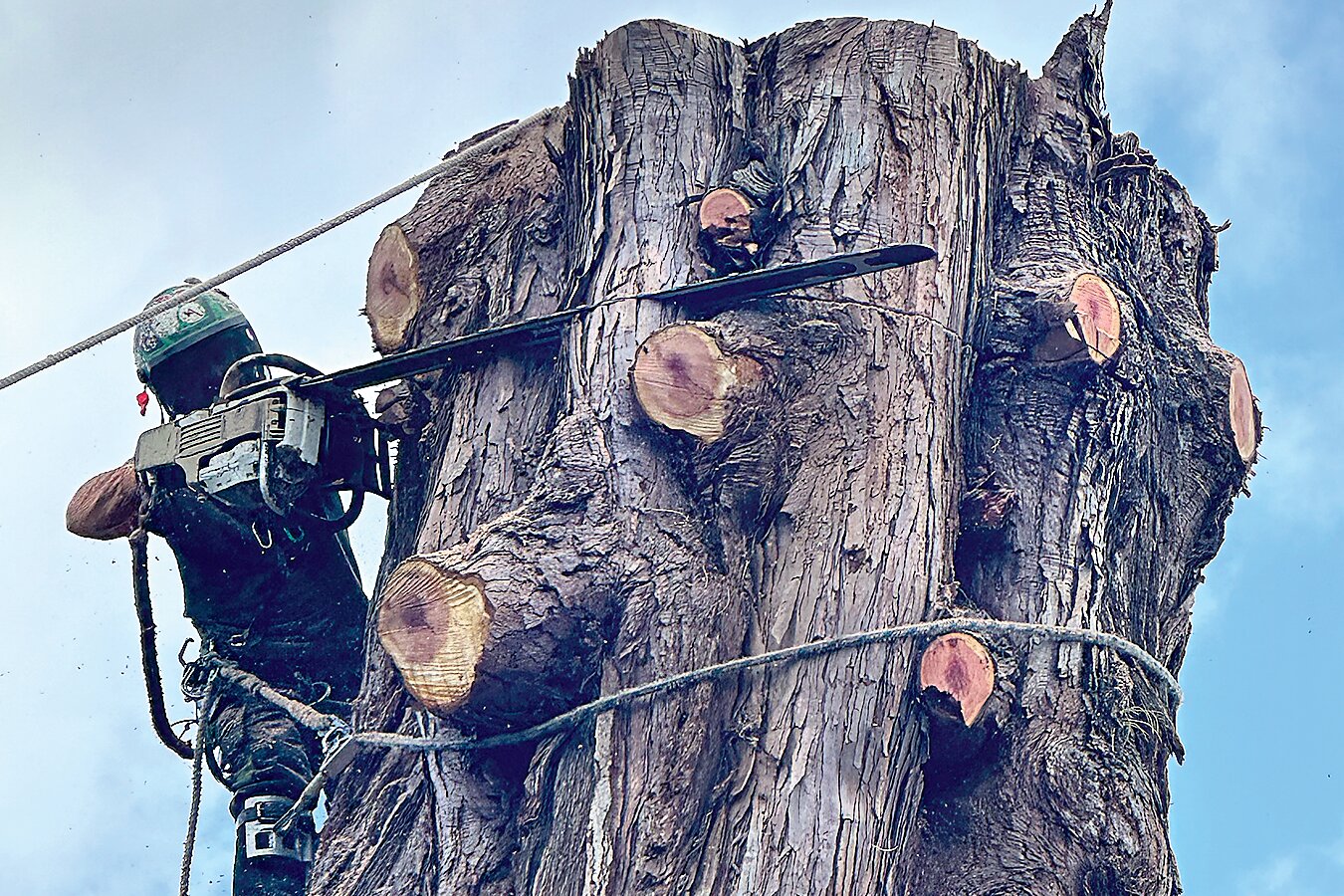 Bigelow’s business is booming. The Everett resident is so busy sometimes that he’s had to tell a referral company, which offers him jobs, that he has all the business he can handle. His services are in demand from municipalities, insurance companies, tree service companies, businesses, homeowners associations, and individual homeowners. He began a recent week on an inventory of trees on a hillside and an environmentally critical area for a Bellevue homeowner. The next day, he pruned trees near a cell tower at the 145th Street exit on Interstate 5 in Seattle.
Then, a homeowner in Snohomish wanted to remove three cedar trees in the middle of the backyard. The homeowner retained all of the trees bordering the property but wanted the other ones – 3 to 4 feet at the base – to be removed. Before he cuts down any tree, though, Bigelow must be up to date on the latest codes. Each city has its own rules and regulations on tree removal. “I have to know how to find that information because they change it all the time. There really isn’t a standard. So you really have to know where you are working.”
Another job in Renton didn’t go as smoothly when Bigelow ran into governmental red tape. He was working on removing a high-hazard tree overhanging a house. The tree was on a slope; a creek ran through the bottom of the slope. Half of the tree had already failed and struck the house several years ago. The other half was at risk of a repeat occurrence. He called the City and asked what his buffer zone to the creek should be. “I think it took me two and a half months to finally get approval.” He wasn’t happy with the delay. “I’m the guy who has to climb this tree. ‘Can we move this along?’ The longer it takes to get approval, sometimes the more dangerous the tree is. They don’t get safer the longer you wait.”
Though he removes a lot of dead or dangerous trees, Bigelow would rather save a tree by pruning or otherwise mitigating the risk rather than removing it. He offers clients several options. “That’s just part of being a professional. Sometimes you can prune a tree. Sometimes you can install a cable or brace system to help support a defect in the structure of that tree. Sometimes we do removal because the tree is decayed. If there’s a defect in the tree, the sooner it can be addressed, the more options you have.”
A homeowner contracted Bigelow to assess a tree the arborist had determined had a 40-inch cavity, or defect. Loads against the defect would increase the chance of the tree’s failure. So he offered three options. The first was to retain and monitor the tree, but it would continue to be high risk. The second was to install a cable and bracing system to attempt to hold the tree together. The third option was removal – resulting in zero risk.
So it goes without saying that tree removal can be a complicated and lengthy process, especially in the city.
“I guess the fun saying is, ‘When in doubt, rope it out.’ You can’t just cut a tree into pieces and let it land where it’s going to land. A lot of our work is in the urban environment. And in the urban environment, everything’s expensive, and you don’t want to break anything.”
This year is Bigelow’s 12th as an arborist. The 43-year-old has the scars to prove it. “My hands are like one giant scar,” he said. Scars also line the lower part of his body. And while arborists wear protection against chainsaws, the back of his pants do not offer it.
 Most crew members (a crew typically runs from three to nine members) are younger than him – in their 20s and 30s. Bigelow started his arborist career in his early 30s, older than most in the profession. “That kind of saved me some wear and tear, where most guys that are my age don’t want to go out and climb trees every day. But that’s something you gain with experience and getting older – your patience. You gain respect for your limitations. Trees are very big, and people are very small.”
Aside from his fall from a tree, Bigelow hasn’t had any other close calls. His experience has helped keep him safe and avoid the serious injuries and accidents others go through. Being in the right state of mind helps him make sound decisions to help keep him safe. Sometimes it’s as simple as not taking unnecessary risks. “That’s part of the experience – knowing what is taking a chance versus having another option to accomplish the same thing.”
Nobody does anything worth doing on their own. He compares his crew to a football team. The team has a coach and Bigelow is the quarterback; he plays with a group of guys for the coach. “It’s my job to call the plays, either based on what the coach tells me or what I think is the right direction at the time. But plays can change, and you can make a play from the ground, but once you get 10 feet up in that tree, you might change the play completely.”
Experience is knowing what play to change to. “Just because I came up with a plan at 8 o’clock when we showed up at 9 o’clock, it’s my prerogative to change that to accomplish the best outcome.”
Worker safety is the most important part of that outcome. “Roofs can be fixed. Fences can be rebuilt. You can’t rebuild a person.”


Comments
No comments on this item Please log in to comment by clicking here