Thursday, October 1, 2026

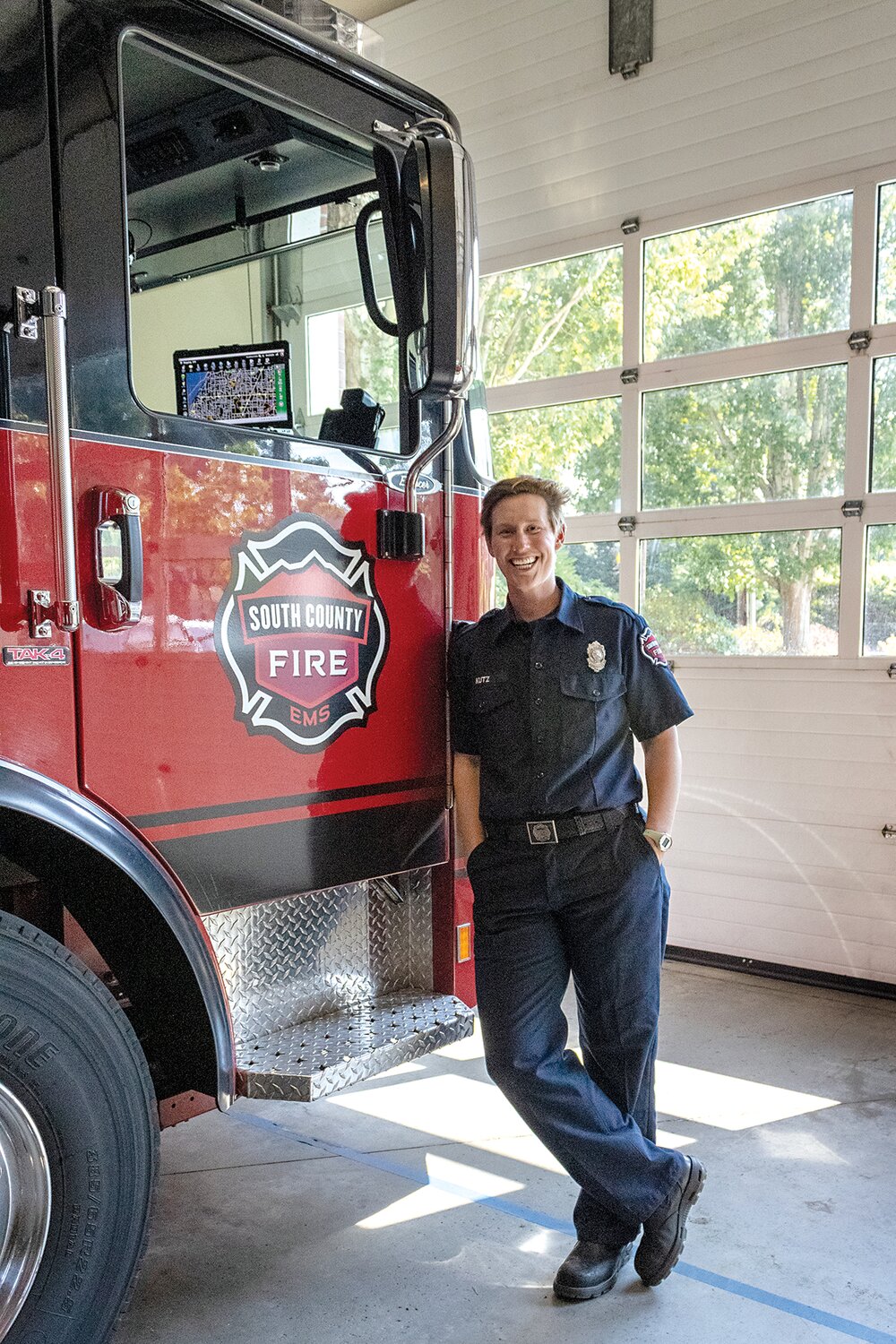 Firefighter Alison “Ally” Kutz of Fire Station 16 in Edmonds starts her day like everyone else – depending on which alarm wakes her up.
Most of us have an alarm clock system to ensure we’re up on time, possibly a series of alarms for those regularly too comfortable to get out of bed. However, firefighters can also wake up to an emergency alarm, Kutz said, which is why some fire station crews adapt their sleep patterns to better match the call volume of their area.
“I love my job,” she says with a wide grin. That includes the dorm-like environment of the station. Everyone takes turns cooking, cleaning, and pitching in for groceries, and there have been times when the crew sat in a circle building medical kits. You’d be right to guess they go through a few.
She also enjoys participating in community outreach. National Night Out is a favorite. Kutz, a youth pastor at CTK Hope Church in Burlington and the youth director at ReImagine Ministry in Mount Vernon, enjoys interacting with the community and seeing the excitement in children’s faces when they spot firetrucks and their accompanying equipment.
Born in Everett and raised in Mount Vernon, Kutz, 34, started on a path far from that as a first responder. In her teens, she was a star athlete at Mount Vernon High School. She was a starting softball catcher for four years, serving as a two-year captain and earning three-time first team All-Northwest League honors.
She earned a bachelor’s degree in exercise and sport science in 2013 from Oregon State University. After graduation, she coached softball at the University of North Dakota. She was also a starting guard for the basketball team, a second-team All-Northwest Conference selection, and a two-time academic state champion. Her progression to coaching was natural and assumed by many, but something was missing, something that coaching the Fighting Hawks didn’t fulfill.
“I can’t just work a job to work it,” she said.
As a person of faith, she prayed for guidance on finding happiness and spiritual fulfillment. The answer was to return home to Puget Sound and become a firefighter. She was one of 20 recruits to start the South County Fire Academy in 2022, and has served the community since.
The first thing Kutz does after her morning coffee is what is called a rig rundown. Every piece of equipment, even the truck’s design, is used to protect or save lives, including those of the responders.
Everything from seat belts to door latches is checked, along with the extensive inventory. Bandages, buckets, gauze, gloves, fire suits, a chain saw, air tanks, and much more are inspected and inventoried before a truck leaves the station, packing 500 gallons of water. Kutz said larger trucks haul 750 gallons.
The Fire Station 16 crew goes through many medical kits, which leads to frequent restocking.
“When you’re on a call, you’re not keeping track of your supplies; you’re focused on helping the patient,” Kutz said. “Stuff goes flying everywhere.”
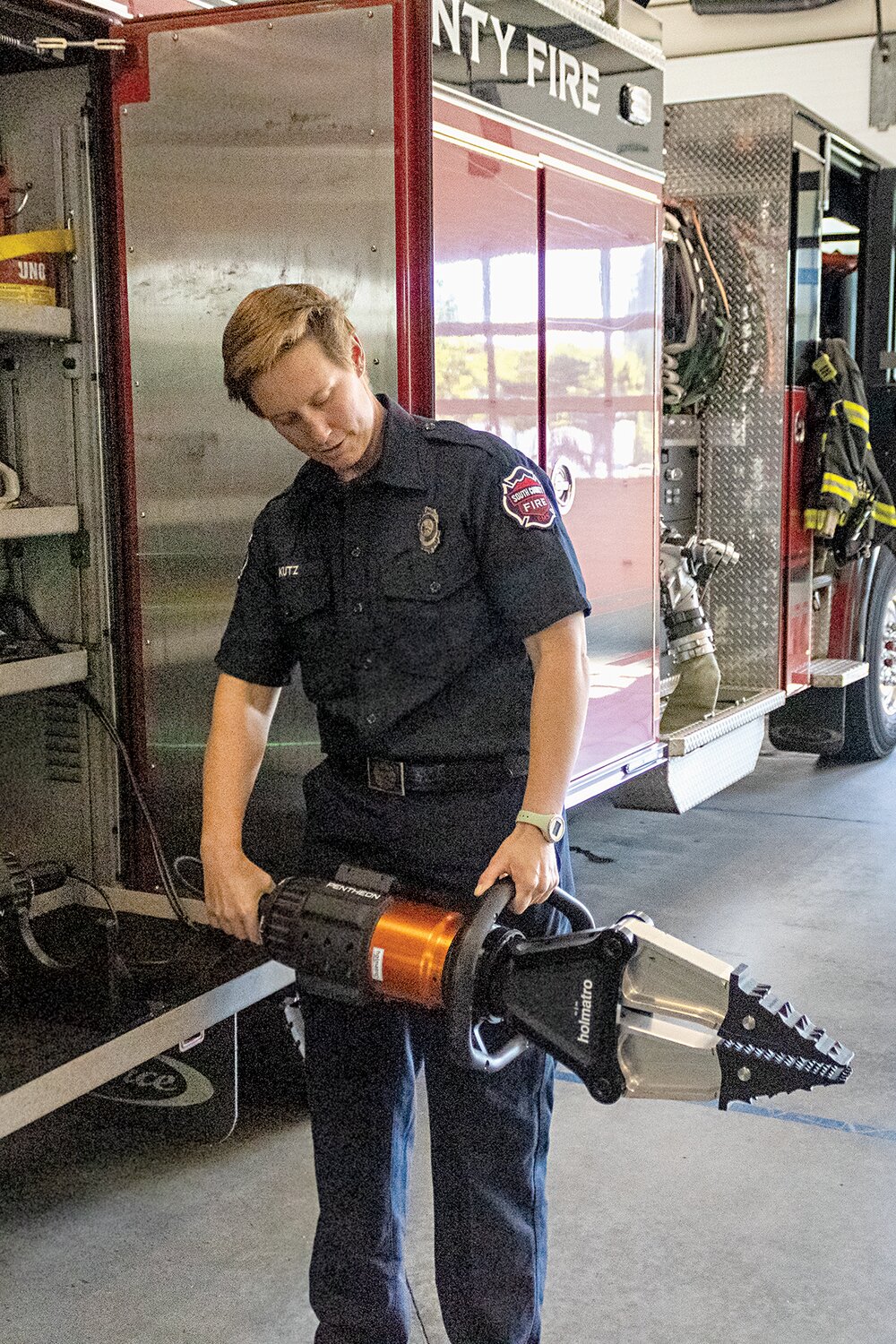
Two pieces of equipment that would catch anybody’s interest are what appear to be parts from a large robot. A large pair of powered shears and a device called a “spreader” are, interchangeably, the Jaws of Life. Properly referred to as hydraulic rescue tools, they have separate functions: one cuts, while the other pulls the steel apart.
The cutting tool can slice through a car’s main support post, and the spreader, resembling a claw, is designed to open rather than grasp. It’s most often used to open stuck vehicle doors. Once fitted, it uses a hydraulic force powerful enough to bend a vehicle’s steel beams and doors.
And if the hydraulic tools can’t cut it, a circular saw with a blade about a foot and a half wide will.
When not maintaining equipment, there is also training on new gear and techniques, reviews of established skills, and drill exercises at a training tower in Everett. However, Kutz said keeping in physical shape is up to the firefighter.
When asked if strength or cardio training was more important, Kutz said, “Both.” A firefighter’s kit can weigh from 45 to over 100 pounds, depending on which tools are needed. Also, the air bottles the fighters use only have about 20 to 30 minutes of air.
Of the equipment inspected on fire rigs, air tanks are a key component of several pieces of gear that protect firefighters. When responders use the tanks, it means the air is unsafe due to smoke or other airborne toxins.
Fighting fires is Kutz’s favorite part of her job, but she knows how dangerous it is. Ceilings and floors weakened by the flames could collapse. Responders could get separated from their crew due to smoke or fallen debris, making teamwork crucial.
Although building fires are dangerous, they are easier to extinguish, use less water, and are typically less toxic than electric vehicle fires. She said the vehicle’s lithium battery pack emits toxic fumes as it burns and requires up to three times the water needed to extinguish a house fire.
What makes an electric fire more dangerous is how prone it is to reigniting. Kutz said that, in the past, some batteries would reignite while being towed, which is why a specially designed wrap is used.
The wrap goes over the car, extinguishing open flames and preventing reignition by depriving the heat source and materials of oxygen. This allows the vehicle to be safely towed.
However, dealing with fires is just 9.2% of the calls South County Fire receives.
There are many aspects of being a firefighter that make it difficult to explain an average day. An average week may be more appropriate. The location of the firehouse could dictate when and what kind of calls are received.
Medical-related emergencies make up the majority of a firefighter’s calls, Kutz said. The South County Fire 2024 annual report showed 84% of the calls to South County Fire are medical, which helps explain chronically depleted medical kits.
Kutz explained that, although they may not look like it, firetrucks are outfitted with the same lifesaving equipment as an ambulance; it’s just not able to transport patients. “We’re there to keep them stable until the paramedics arrive.”
Fire crews are the first on the scene of an emergency because of the equipment they have available. Paramedics have specialized gear to deal with medical emergencies, but they do not have equipment to protect them from hazardous chemicals or to free someone from an enclosed space, such as an elevator or car.
Firefighters even receive basic self-defense training, not for literal fisticuffs with flames, but to defend themselves from people. Much like how a drowning person can unintentionally take their rescuer down with them by acting out of terror, first responders could accidentally be harmed by those they are trying to help. Chemicals could make some people aggravated – or someone in an altered mental state from trauma could irrationally strike out, Kutz said. Further, if drugs or alcohol are involved in the emergency, the person may have no rational awareness at all.
However, Kutz said that contributing to the community while answering a calling that ended up being a job she loves is something she couldn’t have dreamed of. And it seems that the flame continues to the next generation.
A little boy dressed up as a firefighter came to the station one day to see if the garage was open and to get a peek at the trucks. As luck would have it, Kurtz noticed the boy and his father and gave them a tour of the garage and the rig. And as a bonus, the little boy got his own South County Fire baseball cap. “The smile on his face,” she said. “That made his day, and that makes it all worth it.”


Comments
No comments on this item Please log in to comment by clicking here